The Lawnmower Zamboni Will See You Now: Winter Lessons From Ohio’s Backyard Rink Builders
By the time most Ohioans are dragging hoses into the garage for good, a certain breed of neighbor is dragging them back out. Backyard rink builders do not wait for a frozen pond or a municipal sheet of ice. They look at a flat lawn, a shade line, and a water bill, and they see a season.
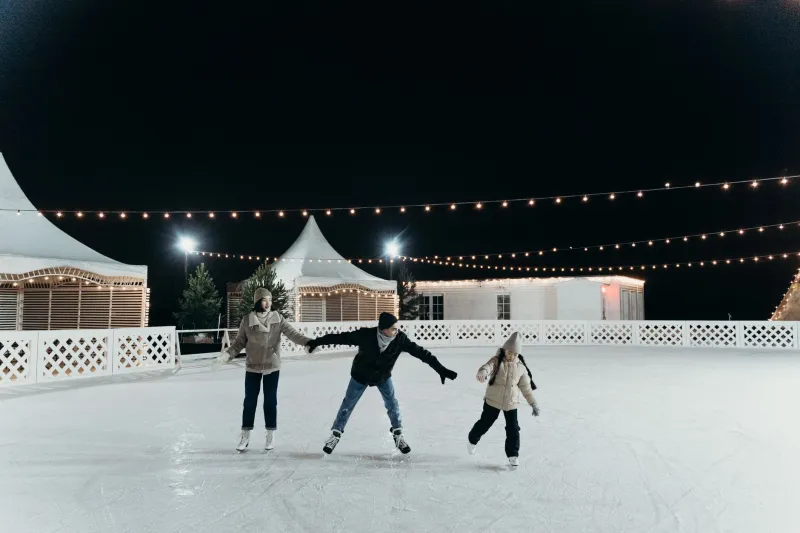
I spent a cold Saturday in Wayne County with a family that has turned that vision into a ritual. Their rink is not enormous — maybe 24 by 40 feet — but it has hosted 19 consecutive Ice Bowl cookouts, an event that started as a few kids skating after church and has become a midwinter potluck with chili, kielbasa, cocoa, and more extension cords than a holiday display. Last February was No. 19. This winter they are bracing for No. 20.
At OH Wa FG, this is the sort of hobby that lands squarely in our wheelhouse: modest, homemade, and better with a casserole.
The rink starts as a rectangle of stakes
The family’s build begins in late November, when the ground is cold but not frozen solid. They pound wooden stakes into the lawn, run a string line to keep the corners square, and unroll a white liner that looks like a giant shower curtain. The first flood is shallow — maybe half an inch — and the waiting is the hard part. If you add water too fast, you get a slushy mess and a liner full of wrinkles. If you add it too slow, you get a rink by Valentine’s Day.
The real currency in this community is not ice. It is hose adapters. One neighbor has a heated hose he swears by. Another has a splitter that lets two hoses run at once. Someone else owns the long wand attachment that reaches the far corner without dragging a hose across fresh ice. These items circulate all winter, borrowed and returned with the solemnity of library books.
The lawnmower Zamboni will see you now
The most celebrated piece of equipment in the Wayne County crew is a 30-year-old lawnmower that has been retired from grass duty and fitted with a plywood box, a towel, and a small tank. It is not a Zamboni. Do not call it a Zamboni unless you are prepared for a lecture. It is a resurfacer, and it does one thing well: it drags a thin sheet of warm water across the ice while the driver goes very slowly and tries not to think about the blade.
The machine gets passed around like a family recipe. One family borrows it for a Saturday, returns it with a fresh tank of water, and leaves a batch of cookies on the seat. The next family does the same. Nobody keeps score, mostly because the resurfacer is held together with hose clamps and goodwill.
The Ice Bowl is a potluck with a whiteboard
The Ice Bowl started in the early 2000s as a way to get the kids outside during the long stretch between Christmas and spring. No one remembers the exact first year, which is how you know it is a real tradition. The rules are simple: bring something that can sit on a folding table in the cold, wear shoes you can kick off at the door, and do not slap shots at the goalie unless the goalie is your own child.
The host family supplies the ice, the lights, and a thermos of coffee that has been known to outlast the party. Neighborly one-upmanship is allowed but must be gentle. One year a family brought a hot chocolate station with three kinds of marshmallows. The next year someone built a warming bench out of pallets and a moving blanket. This is how it goes. There is no scoreboard, but there is a whiteboard for hotly disputed goals.
Why the ice matters
Backyard rinks are a lot of work for a few weeks of skating. The liner can tear. A January thaw can turn the whole project into a shallow pond. The water bill arrives like a bad review. And yet the builders keep doing it, because a sheet of ice in the backyard does something that a municipal rink cannot. It turns a neighborhood into a schedule. Kids knock on doors. Parents stand around with mugs. Someone brings chili. Someone else brings a shovel.
At last winter’s Ice Bowl, the ice was soft by 2 p.m. and perfect by 8. The kids played until their cheeks were red. The adults talked about hose adapters, the price of plywood, and whether the forecast would hold. Nobody mentioned the news. It was, by all accounts, the most wholesome winter potluck in the state — or at least the one with the best resurfacing equipment.
If you have a flat yard and a free weekend, the community will find you. Someone will lend you an adapter. Someone will tell you your liner is wrong. Someone will bring chili.
Sidebar: Build your own rink for the 2026–27 season
- Find a flat, shaded spot. Morning shade helps ice last. Avoid low spots where water pools.
- Measure twice. A 20-by-30-foot rink is plenty for a family; bigger means more water and more liner.
- Use wooden stakes and a string line. Keep corners square and leave room for a snow pile.
- Buy a liner sized larger than the rink. Fold the excess over the boards; do not trim until spring.
- Flood in thin layers. A half inch at a time, letting each layer freeze before adding more. Start after a hard freeze and avoid warm spells.
- Make a simple resurfacer. A hose with a spray nozzle and a towel dragged behind a sled can work. The lawnmower version is optional and should be built with safety in mind.
- Light it safely. Use outdoor-rated lights and extension cords; keep connections off the ice.
- Set rules early. No skating alone, no slap shots at small kids, and no walking on the liner before it freezes.
- Budget for next year. Liners, boards, and water add up; many builders start with used materials and upgrade slowly.