Six Months of Checking a Painted Bowling Ball: What I Learned From Ohio's Lawn Forecasters
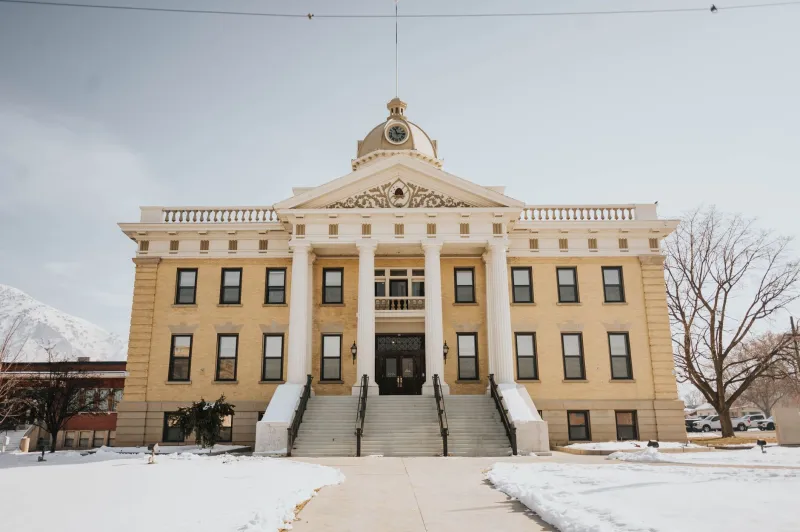
The first thing you should know about the Weatherball in Mt. Gilead is that it is not, technically, a ball. It's a bowling ball — a fifteen-pound Ebonite somebody's uncle drilled in 1987, painted silver, and mounted on a length of rebar driven into the courthouse lawn. The second thing you should know is that nobody in town considers this strange.
"It's been right more often than that fella on TV," Dorothy Kinsel told me, and she's the keeper, so she would know. Or at least she'd say she does.
How a Weatherball Works (According to Its Keepers)
The rules are simple, which is probably the point. If the Weatherball is dry, fair weather ahead. Wet? Rain within a day or two. White? Snow. Shadowed at dusk on February 2nd? Six more weeks of winter, same as any groundhog, but without the travel.
Dorothy checks it every morning on her walk to the pharmacy. She keeps a spiral notebook — going on her fourth — with dates, conditions, and a confidence rating she invented herself. "Mostly right," "dead wrong," and "don't recall" are the only entries. "Don't recall" is winning.
Five Towns, Five Fixtures, Five Arguments
Mt. Gilead's bowling ball is the most famous, but it's not alone. Up in the lake counties, there's a painted cinder block known as the Frost Brick, refreshed every August by the Lions Club with whatever exterior paint was on sale. Down toward the river, a barber-pole-striped fence post in a village square serves as a barometer in the sense that "when the stripes fade, weather's coming."
And in two more towns I'll leave unnamed because the keepers asked me to — more on that later — there's a groundhog statue carved from a tree stump and a hubcap nailed to a utility pole that gleams when a storm's within fifty miles. Or when the sun's out. Depends who you ask.
The keepers do not agree with each other. That's part of the fun. At a potluck in Morrow County last fall, I watched two of them debate snow prediction methodology for forty-five minutes while the rest of the room talked over them about church raffles. Neither budged. Both were right, according to their own notebooks.
Why Not Just Check Your Phone?
I put the obvious question to every keeper. You have a smartphone. The National Weather Service has satellites. Why consult a painted ball?
The answers were all variations on the same theme. "The phone doesn't know here," one keeper told me, gesturing at a valley where frost pools every October. "The ball lives here."
There's something to that. Hyperlocal forecasting is a real problem — a county warning covers a lot of ground, and hilltop weather is not valley weather. The Weatherball is always exactly where you are. It has a perfect observational record for its specific patch of lawn.
But honestly, the accuracy argument is a fig leaf. What keeps these fixtures alive is that they give a town a shared thing to squint at. Checking the Weatherball is a social act. It comes with conversation, a little theater, a reason to stop on the courthouse lawn and grumble about February together. The weather app offers none of that. It just tells you it's cold and leaves you alone with the information.
The Keeper Succession Problem
Here's the tension underneath the tradition: every keeper I met is retired, and none of them has an obvious successor. Dorothy's notebook will go to whoever wants it, but "whoever wants it" is a shrinking category. The Frost Brick's painting crew is down to three Lions, average age somewhere north of seventy.
One keeper told me her grandson suggested "just putting a little weather station on it, like a sensor." She allowed as how that might be fine someday. "But the sensor won't get painted. The sensor won't get argued about. The sensor won't need somebody to walk past it every morning."
Two keepers asked me not to name their towns, worried that a write-up would bring vandals or, worse, tourists who'd treat the fixture as a photo op rather than an institution. That's a genuine fear when your civic monument costs eleven dollars in paint and rebar.
Go Look Yourself
If you're driving through Mt. Gilead, the Weatherball is on the south side of the courthouse lawn, roughly at eye level if you're a tall kid. Look at it. Check it against the sky. Log your own entry, mentally at least.
Will it be right? Statistically, no better than a coin flip. But a coin flip never gave Dorothy Kinsel a reason to walk past the pharmacy every morning for thirty years, notebook in hand, arguing with the sky. Some forecasts are about the weather. The good ones are about the town.
If you know of a lawn forecaster we missed — a painted rock, a buzzing ping-pong ball on a coat hanger, anything — send it our way. We're keeping a list, and the list is getting weird.