Bare Hands, Borrowed Manners: An Afternoon in Ohio's 1860s Base Ball Circuit
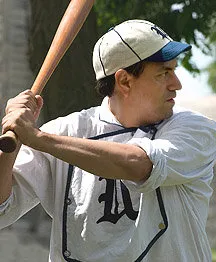
Photo: Johnmaxmena (talk), Public domain, via Wikimedia Commons
The first thing you notice is the hands.
It's a Saturday in early autumn, a flat mown field behind a county park outside Lebanon, and nine men are standing in the outfield with their bare palms turned up like they're checking for rain. No gloves. There are no gloves in 1860, which is roughly the year this match is pretending to be. A line drive comes off the bat and the left fielder takes it on the meat of his hand, grimaces, and throws it in.
"That one'll be a bruise by Tuesday," says a spectator in a folding chair, sounding delighted.
The rules, as quickly as possible
Vintage base ball — the two-word spelling is deliberate, and correcting people about it is a beloved pastime — is a loosely organized national hobby with a couple hundred clubs, and Ohio has somewhere in the neighborhood of two dozen, depending on how you count the ones that play three matches a year and the ones that are basically one enthusiastic family.
A few things that surprise first-timers:
- The pitcher throws underhand, from a box, at a conversational pace, and is called a hurler. The point is to give the striker something hittable. A hurler who tries to blow it past a batter is considered a bit of a jerk.
- The striker can call for a high or a low pitch. This is not a suggestion. It's a rule. The umpire will ask.
- Foul balls caught on one bounce are outs. So are line drives caught on the fly. There is no foul territory home run and no protective netting anywhere.
- No gloves, no helmets, no batting gloves, no sliding pads. Cleats are usually tolerated for safety, which is one of several places where modern clubs quietly break with 1860.
- You can't leave the baseline to avoid a tag, and the old practice of "soaking" a runner — throwing the ball at him — had already been retired by the decade most clubs reenact. Somebody will explain this to you incorrectly at least once per match.
- The umpire is addressed as "sir" and gets one fan. Clubs often borrow an umpire from a third club, which is why the arguing sounds more like a zoning board than a ballgame.
"We don't yell at him," says the club's captain, a high school history teacher who plays under the name of a 19th-century merchant. "We petition him. Politely. Loudly, but politely."
The uniforms are a research project
The wool is real. In September it's miserable; in April it's worse. But the club treats the kit as an archival exercise rather than a costume, and the arguments in the off-season are about fabric weight and button spacing, not batting order.
One member keeps a binder. In it are photocopies of period photographs, catalog pages from Cincinnati dry goods merchants, and notes on which Ohio regiments mustered out in which year wearing what. The shirts are sack coats with no numbers, because numbers weren't standard until much later. The caps are kepis for one club and flat caps for another, and there's a running, entirely good-natured feud about which is right for 1864.
"If someone walks up and asks why we're not wearing gloves, that's a teachable moment," one player tells me between innings. "If someone walks up and asks why the buttons are wrong, that's a friend."
What an inning actually feels like
Slow. Pleasantly slow. A match takes about two hours, and maybe forty minutes of it is baseball.
The rest is: the hurler checking with the striker about whether he'd like it high or low; the umpire conferring with both captains about whether that foul ball had a hop in it; a toddler wandering onto the field and being gently escorted back by a right fielder in a wool sack coat; an elderly woman in a lawn chair explaining to a stranger that her grandfather played this game in a pasture in Knox County and that the field they're standing on is probably about the same size.
There's a custom after a good play where both sides applaud. Not just the team that made it. Both sides. It reads as corny for about fifteen minutes and then it reads as the entire point.
Why not just play softball
I asked. Several times. The answers were more interesting than I expected.
Almost nobody said "nostalgia." The word that came up over and over was etiquette — the idea that the game is a structured excuse to be decent to people you don't know. A club needs a roster, a schedule, a treasurer, a guy with a truck, and a relationship with a park district or a historical society. It needs members who will show up in April when it's forty degrees and raining sideways. That's a community organization wearing a baseball uniform.
"Everybody thinks we're doing a Civil War thing," one player says. "We're doing a neighbors thing. The wool is just the excuse."
If you want to watch — or join
Matches are usually free, announced on club social pages, and played at parks, fairgrounds, and the occasional historic site. Bring a lawn chair, a hat, and cash for whatever the club is selling. There is almost always a club selling something, and it is almost always pie.
If you're thinking about playing: clubs range from serious to extremely casual, and most are actively recruiting. The requirements are a willingness to learn the rules, a tolerance for wool, and the ability to lose 14–3 without making it weird. That last one, several players told me, is the only real skill the game tests.