The Sheet Comes Off the Plywood: Setup Night With Ohio's Holiday Model Railroaders
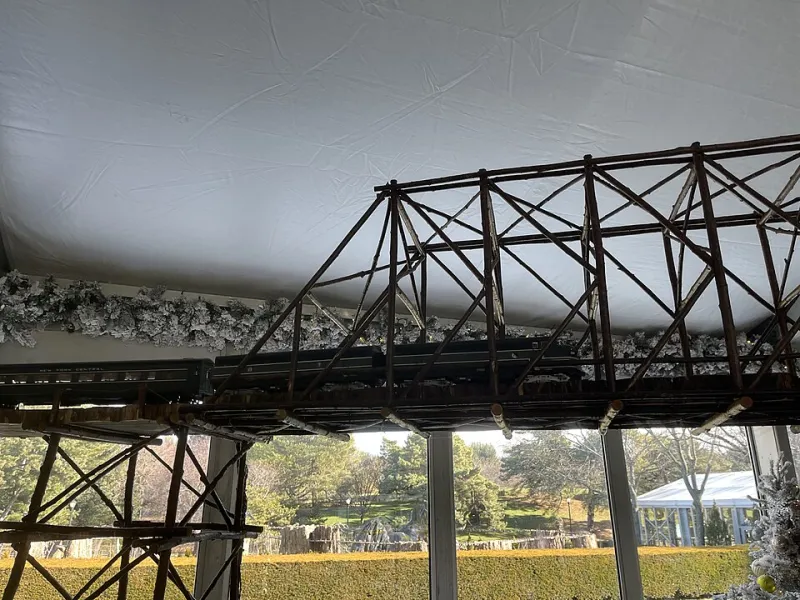
Photo: LostplanetKD73, CC0, via Wikimedia Commons
The sheet comes off a little after seven on a Tuesday night in a church basement outside Newark, and for about ninety seconds nobody says a word. Then somebody's extension cord slaps the floor, a transformer hums, and forty feet of hand-laid track clicks alive under a bank of fluorescent lights that have been waiting eleven months for this.
"Okay," says the club president, a retired lineman named Duane who has been at this since 1974. "Let's find out what the mice did."
This is the ritual. Across Ohio, from Findlay to Marietta, model railroad clubs spend late November doing exactly this: unlocking a room they've barely touched since January, dusting off a layout that took decades to build, and opening it to the public for two or three weekends before it all goes back under a sheet. It's one of the quietest holiday traditions in the state, and one of the easiest to walk into — if you know where to look.
First, the table
The layout itself isn't really a toy. It's carpentry. The base is plywood over a frame of 1x4s, and the frame sits on legs built by whoever in the club owned the best table saw in 1988. Everything above the plywood — the hills, the riverbed, the tiny gravel parking lot outside a feed store — is foam, plaster cloth, and about four decades of accumulated stubbornness.
Duane's club has fourteen members. The youngest is 41. The oldest is 89 and comes for the coffee and the arguing, in that order. They meet twice a month from September to April and once a month in summer, which is when they do the maintenance nobody enjoys: cleaning track, replacing switch machines, and vacuuming out whatever the building's resident field mice have dragged in.
The depot roof problem
By 7:40, a small crowd has formed around a structure the size of a paperback — a two-story brick depot with a bay window and a roof that has never, in the layout's thirty-one-year history, sat perfectly flat.
"It's the same corner every year," says a woman named Phyllis, who is holding a pair of tweezers like a surgeon waiting on a nurse. "Because somebody glues it, and then somebody puts weight on it, and then somebody forgets the weight."
Somebody, it turns out, is usually Gary. Gary is not present. Gary is discussed.
The fix takes eleven minutes and involves a clamp, a hair dryer, and one genuinely tense exchange about whether the roofline should be 1890s or 1910s. It should be 1910s. It gets settled. Phyllis puts the roof on at 7:53 and everyone applauds, quietly, the way you applaud in a church basement.
This is the part that doesn't make it into the photos people take during open house weekends: the bickering. It's affectionate, mostly. But a club layout is a shared artwork with fourteen authors, and the annual reveal means everyone's opinions come back out of the box along with the rolling stock.
What the kids do
At 8:15 the first family arrives — a dad and two kids in pajama pants, tipped off by a Facebook post — and the whole room changes temperature. Adults stand back. Kids go flat on the floor.
That's the correct viewing height, by the way. Model railroads are built at roughly forty inches off the ground, which is eye level for a first grader and knee level for everyone else. The clubs know this. The good ones keep a step stool by the door and a strip of blue painter's tape on the floor about eighteen inches back from the edge, which is the universally understood "hands behind your back" line.
"We don't say don't touch," Duane tells me. "We say look with your eyes and ask me and I'll let you touch the button." There's a button. It rings a crossing bell. A nine-year-old presses it forty times. Nobody minds.
The part nobody drives out to see
The trains get the attention, but the wiring is the actual achievement. Under the plywood is a nest of feeders, bus wire, terminal blocks, and a control panel that looks like the inside of a 1970s mainframe. Half the club runs on direct current, the old way, with block toggles. Two members have been pushing for years to convert to digital command control and have been politely outvoted, which is the model railroad equivalent of a filibuster.
There is also a box. Every club has one. It's the failed-projects box: half-painted water towers, a bridge that sagged, a locomotive that will never run again but is kept because a member who died in 2009 painted the cab by hand.
The layout is never finished. That's not a joke; it's the whole point. If it were finished, you'd have to stop showing up on Tuesdays.
How to find one near you
Holiday open houses generally run the first three weekends of December, and most are free or ask for a canned good or a couple of dollars in a donation jar.
- Club websites and newsletters. Most Ohio clubs post open house dates by mid-November. Search your county plus "model railroad club."
- Church bulletins and library lobbies. A staggering number of layouts live in church basements and fellowship halls, and the announcement goes out through the congregation first.
- Local historical societies. If a layout depicts a specific town, the historical society often co-hosts and will have the schedule.
- Regional train shows. Clubs set up display tables in November and hand out flyers with dates.
- Ask a neighbor. The hobby skews older and quieter, but these people are evangelists. Mention trains at a hardware store in Ohio in December and you'll leave with three addresses.
Before you go
Bring cash for the donation jar and the fifty-cent raffle. Ask before you photograph anyone's face. Don't lean on the fascia — it's held on with drywall screws and hope. And if a member offers to let a kid run a train for one lap, say yes, because that offer is the entire reason they spent eleven months waiting for a Tuesday in November.
The sheet goes back on the second week of January. The mice get the room back. Duane will be down there in February anyway, alone, fixing a switch.