Static, Voice Actors, and a Second Sunday: Inside Dayton's Basement Radio Drama Troupe
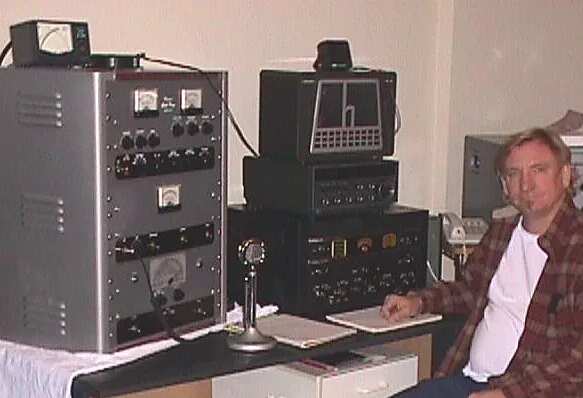
Photo: LuckyLouie, CC BY-SA 3.0, via Wikimedia Commons
The basement smells like solder and coffee. That's the first thing you notice walking into Chuck Ellery's Dayton ranch home, down the stairs past a wall of framed QSL cards — the confirmation postcards ham operators mail each other after making contact — and into a room that looks equal parts broadcast studio and grandpa's workbench.
Four men in their seventies are arguing about a sound effect.
"A creaking door doesn't sound like a creaking door on AM," says Walt, adjusting his headphones. "It sounds like a dying goose. You have to sell it."
This is the Miami Valley Wireless Players, and depending on who you ask, they are either Ohio's most dedicated ham radio drama troupe or the only one, which amounts to the same thing. Every second Sunday evening, they take over a handful of amateur frequencies and perform full-cast radio plays — westerns, ghost stories, a three-part adaptation of Sherlock Holmes that took them eight months — to an audience of licensed operators scattered across the Midwest, listening on everything from basement rigs to car dashboards.
Nobody Asked Them To Do This
"People hear 'ham radio' and they think emergency nets and weather spotters," Chuck tells me, gesturing at a shelf of three-ring binders stuffed with scripts. "Which we do. But at some point I asked, why does the hobby have to sound like a DMV line? Why can't it sound like The Shadow?"
The troupe formed in 2019 after Chuck and Walt met at a Dayton Amateur Radio Association meeting and discovered they'd both grown up on golden-age radio rebroadcasts. Two more members — Ray, a retired Bell Telephone lineman, and Gene, who spent forty years teaching high school drama in Kettering — rounded out the cast. None of them had performed before, technically. All of them had, in some sense, been rehearsing their whole lives.
Their audience is small and mostly invisible. On a good night, they'll get twenty or thirty check-ins from operators as near as Beavercreek and as far as a lake freighter on Lake Erie. On a great night, someone in Ontario will report copying the whole show through a band opening. There is no monetization, no subscriber count, no algorithm. There is, Ray points out, "no way to know if anyone's listening until they tell you. It's like theater, except the house lights never come up."
Dancing With the FCC, Politely
Here's the part that makes a lawyer itch, so let's address it: FCC rules technically prohibit broadcasting on amateur frequencies. Ham radio is meant to be two-way communication, not one-way entertainment pumped out to the masses. The Players are well aware of this, and their workaround is both legal-ish and very Ohio.
"We're not broadcasting," Walt says, holding up both hands. "We're having an elaborate, scripted conversation. Any licensed operator can key up and join in. We invite call-ins between acts. Sometimes a guy in Kentucky comments on the plot. Sometimes he corrects our Ohio River geography, which is rude, but it's participation."
They keep transmissions short, stay within their band privileges, and — this seems to be the real secret — are so charming and transparent about what they're doing that nobody's ever filed a complaint. The local FCC field office, Gene claims, knows about them. "If they had a problem, we'd have heard by now. We're not exactly a threat to national security. We did an entire episode where the villain was a raccoon."
Rehearsal Night
I sat in on the final rehearsal before their spring production, an original script Walt wrote called The Last Toll on the Zane's Trace, a frontier ghost story set along the old Ohio road. It runs forty minutes and requires Chuck to voice five characters, which he accomplishes mostly by adjusting his dentures.
The process is gloriously low-tech. Scripts are printed at the library, 25 cents a copy. Sound effects are physical: a thunder sheet made from a window frame and springs, a pair of boots in a cardboard box of gravel for footsteps, an actual cowbell that Gene refuses to replace with anything electronic. "The mic hears the difference," he says. "Machines always sound like machines."
They ran the third act three times. The first time, Chuck flubbed a line and called himself a name I won't print. The second time, the thunder sheet went off during the wrong line and nobody stopped laughing for two minutes. The third take was flawless, and nobody said anything about it, because that's how it works when you've been doing something together long enough.
Why Bother?
I asked each of them the obvious question — why do this in the age of Spotify, of infinite podcasts, of streaming anything? — and got four different answers, all of which felt true.
Chuck: "Because anyone can make a podcast. Not everyone can make one that travels off a radio tower in their basement and lands in a stranger's kitchen."
Walt: "Because radio drama is a puzzle. You build a whole world out of nothing but sound, and you get one take."
Ray: "Because my wife said I needed a hobby that wasn't just talking to other guys about antennas. This is talking to other guys about antennas, plus scripts."
Gene: "Because somewhere tonight, a twelve-year-old with a cheap receiver is going to hear a ghost story come out of the static and have their whole life bent a little. That happened to me in 1963. I'm just passing it along."
The Miami Valley Wireless Players perform the second Sunday of every month, schedule and frequencies posted through the Dayton ham community. You can't stream them. You can't download them. You just have to be listening — which, they'd tell you, was always the point.
If you know of another troupe doing radio drama over the airwaves — or you've accidentally heard one of their shows while scanning bands — write in. We'd love to hear from the static.